 Professional Family Mediation
Professional Family Mediation
Professional Family Mediation
EH Mediation brings calm, professional support to families navigating change. We help separating couples, co-parents, and wider families move from uncertainty to practical, lasting agreements without the pressure of court proceedings.
EH Mediation works with parents, separated couples, civil partners, and wider family members to transform difficult conversations into clear, workable plans that fit everyday life. Our role is not to tell people what to do, but to create a safe, well-structured space where everyone can be heard.
People turn to EH Mediation because they want to avoid unnecessary confrontation and the expense and uncertainty of formal court proceedings. Many want to protect children's routines and emotional security, keep day-to-day life predictable and fair, and reach agreements about finances and property in a way that respects dignity on all sides.
We begin from a practical belief: solutions are stronger and longer-lasting when they are shaped by the people who will live with them. That means focusing on what matters now school runs, holiday arrangements, shared expenses, and maintenance of the family home rather than abstract arguments that feel distant from everyday reality.
"Solutions shaped by the people who will live with them."

Mediation conducted by trained, neutral professionals provides a framework that informal conversations cannot replicate. Professionally facilitated sessions are structured to prevent escalation, manage power imbalances, and keep discussions focused on practical outcomes rather than historical grievances.
Everything discussed in mediation remains confidential within clearly defined limits. This creates the safety to speak openly and explore options without fear of those discussions being used against you later.
Mediation typically resolves matters faster and with far less emotional cost than contested court proceedings. Keeping decisions with the people directly affected means agreements are reached on a human timescale.
Agreements reached collaboratively are more likely to be followed and sustained. When people feel genuinely heard and have actively shaped an outcome, compliance and cooperation tend to follow naturally.

The mediation process is designed to be transparent, manageable, and flexible. Each stage builds on the last, moving from initial exploration to practical, written outcomes. The pace is guided by the complexity of the issues and the needs of those involved.
A brief introductory conversation to understand your situation, answer initial questions, and explain what mediation involves. There is no commitment at this stage.
The Mediation Information and Assessment Meeting establishes whether mediation is appropriate for your circumstances and introduces the process in practical terms.
Before joint sessions begin, the mediator helps identify the key issues, gather relevant information, and establish a structure that keeps discussions focused and productive.
Joint or shuttle sessions explore the issues in depth. The mediator facilitates, summarises, and helps both parties move from general concerns to specific, workable decisions.
Decisions are recorded in clear, plain language — whether a parenting plan, a financial summary, or an outline of next steps. Both parties leave with a document they understand and can use.
EH Mediation supports many different family configurations and types of disputes. If you are facing a difficult conversation about children, finances, property, or co-parenting, mediation may offer the right environment to move forward.
Couples ending a relationship who need to reach agreements on finances, property, and practical living arrangements.
Parents who need to establish or revise arrangements for children, including time, routines, handovers, and communication.
Civil partners navigating dissolution who need support structuring practical and financial arrangements respectfully.
Grandparents, siblings, and other relatives involved in decisions about care, living arrangements, or family responsibilities.
Unmarried partners separating after years together, who face complex questions about shared property, finances, and assets.
Families managing major transitions — including care for older relatives — who need a structured space to make sensitive decisions together.

Mediation is most effective when it engages directly with the real, day-to-day issues that matter to families. EH Mediation covers the full range of practical concerns that arise during separation and family change.
Where children will live, how they will divide time between parents, and how transitions will work day to day. This includes weekday and weekend schedules, school runs, extracurricular activities, holiday planning, and handover logistics.
Discussions focus on stability predictable routines, consistent expectations across both homes, and respectful communication between adults that allows children to remain free from tension.
How jointly held property will be managed, how mortgage or rental costs will be handled during transition, what division of savings and assets makes sense, and what timescale is realistic for selling or transferring ownership.
Mediation helps break complex financial questions into manageable pieces so decisions can be made with clarity rather than under pressure.
Agreeing preferred methods of contact, reasonable response times, how school information is shared, and how extracurricular decisions are made. Building review points into arrangements so they can be updated as children grow or circumstances change.
Clear communication systems reduce unnecessary friction and protect children from being caught between competing expectations.
Families supporting older relatives or those with additional needs often face highly sensitive decisions about living arrangements, daily care responsibilities, financial contributions, and long-term planning.
Mediation provides a structured, respectful environment in which these conversations can take place without blame or escalation.
Mediation does not guarantee any particular outcome, and it would be misleading to suggest otherwise. What it does provide is a structured, professionally managed environment in which the people most affected by a situation have the best possible conditions to reach their own decisions.
For many families, mediation produces detailed, practical parenting plans that cover living arrangements, school logistics, holiday scheduling, handover procedures, and review mechanisms. For financial matters, it can result in written summaries of agreed steps timelines for property decisions, clarity on shared expenses, or a framework for dividing assets — which can then be taken to solicitors for formal documentation if required.
Where issues are complex or feelings run particularly high, mediation may take longer or may resolve some but not all matters. In those cases, partial agreements are still valuable, and the mediator will explain clearly what further steps including legal routes may be appropriate. If mediation is not suitable from the outset, that will be identified early and you will be directed to appropriate alternatives.
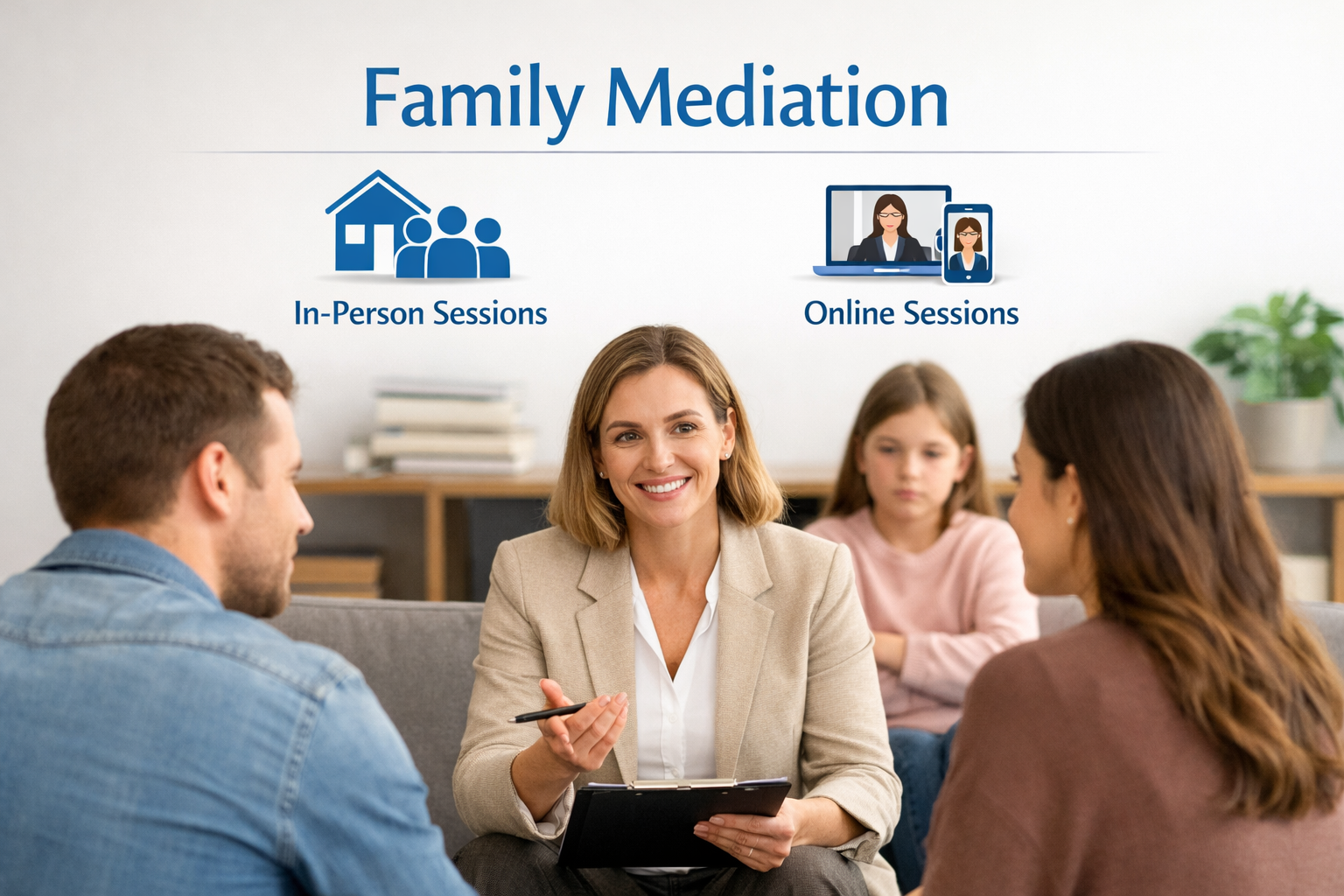
The integrity of the mediation process depends on safety, neutrality, and confidentiality. EH Mediation maintains rigorous standards in all three areas, with specific procedures in place for situations where additional care is needed.
Mediators do not take sides, offer opinions on the merits of either person's position, or provide legal advice. Their role is to facilitate a fair process — not to advocate for any outcome.
Where concerns about domestic abuse exist, mediators are trained to assess the situation carefully. Mediation is not appropriate in all cases, and where it is not, referrals to specialist support services are made promptly and with discretion.
Mediation is confidential within clearly defined limits, which the mediator explains at the outset. Parties are informed of what confidentiality covers, what records are kept, and under what circumstances information might need to be shared.
Techniques including private sessions, shuttle mediation, structured agendas, and careful time management are used to ensure both parties can participate equally and that decisions are not rushed or unduly influenced.
The welfare of children and vulnerable individuals is a constant priority. Mediators take their safeguarding responsibilities seriously and handle disclosures with the care, seriousness, and discretion they require.
EH Mediation is composed of trained, experienced mediators committed to professional standards. Our practitioners combine practical expertise with genuine sensitivity to the emotional realities of separation.
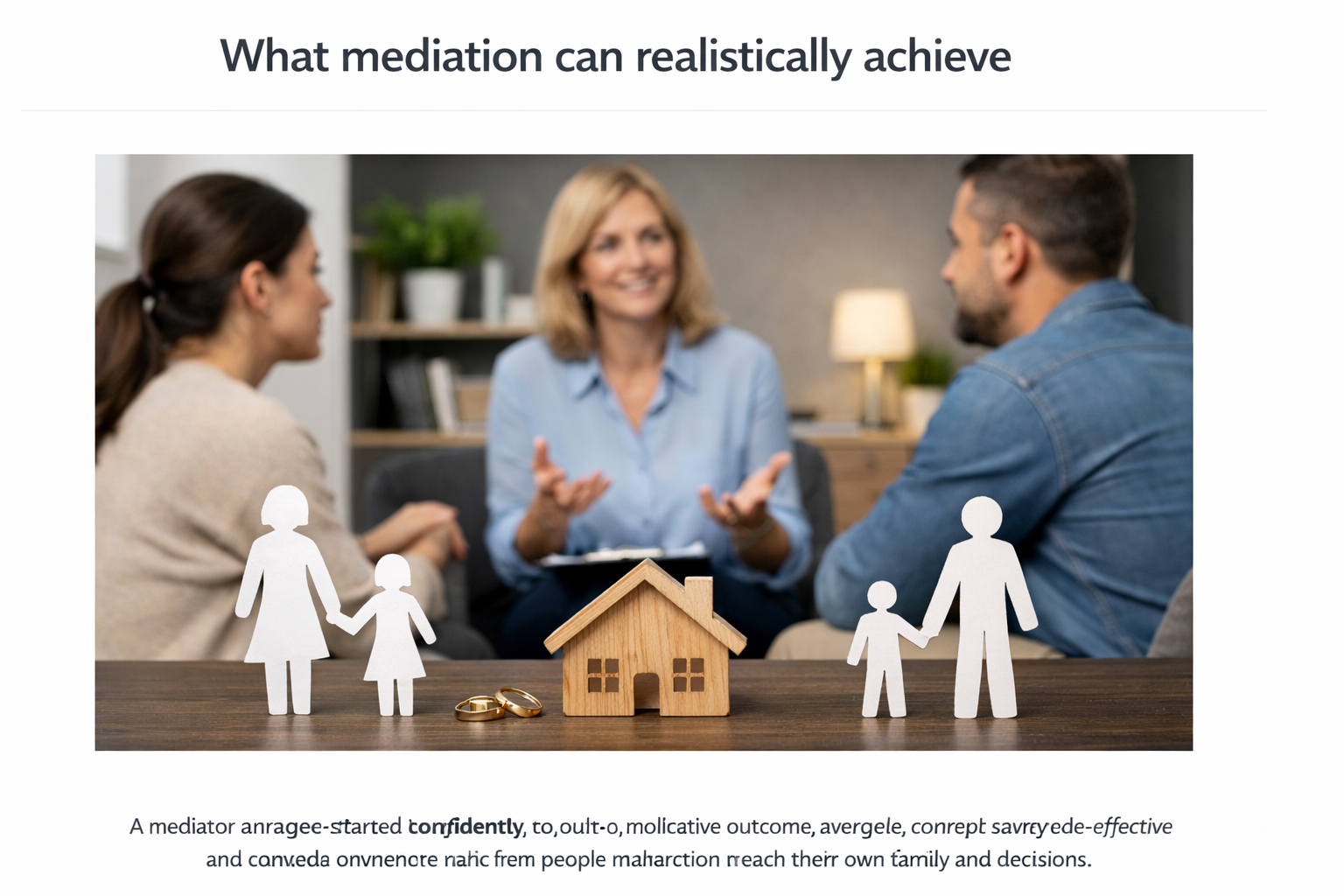
Reaching agreement is the beginning, not the end. EH Mediation helps ensure that what has been agreed is clearly documented, practically workable, and set up for long-term success. Where further steps are required, you will be informed and supported in identifying them.
All decisions reached in mediation are recorded in plain language. Parenting plans include specific detail about routines, handovers, communication, and review points. Financial summaries describe agreed steps, timelines, and responsibilities clearly so both parties leave with a document they can rely on.
Where legal formalisation is desired — for example, a consent order for a financial agreement — the mediator will explain the process and recommend seeking independent legal advice from a solicitor. Mediation and legal advice complement each other; one does not undermine the other.
Good agreements include planned opportunities to revisit what has been decided. Mediation can help parents and families build review points into their arrangements so that when circumstances change — as children grow, or life evolves — there is an agreed structure for revisiting and adjusting the plan.
If new issues arise after an agreement has been reached, or if circumstances change significantly, mediation remains available as a route for revisiting specific matters without returning to adversarial proceedings.
Mediation is a voluntary, confidential process in which a neutral third party helps people reach their own agreements. It keeps decision-making with the individuals involved rather than placing it in the hands of a judge. Court proceedings are adversarial and can be costly, time-consuming, and emotionally demanding. Mediation often resolves matters faster, at lower cost, and with outcomes that the parties themselves have shaped and are more likely to sustain.
In many circumstances, a MIAM is a required first step — particularly where someone is considering applying to a court for a family matter. The MIAM is also a genuinely useful meeting in its own right: it allows the mediator to assess whether mediation is appropriate and helps you understand what the process involves before committing to it. It is not a commitment to proceed.
Safety concerns are taken seriously from the very first contact. If you have any worries about personal safety, domestic abuse, or pressure from the other party, raise these during your initial contact or MIAM. The mediator will assess the situation carefully and explain all available options. Mediation is not appropriate in every situation, and where it is not, referrals to specialist support services will be made.
Mediation itself produces written documents — parenting plans, practical financial summaries — that are based on mutual agreement. These are not automatically legally binding. Where legal enforceability is required, such as a consent order for financial arrangements, the mediator will explain the next steps and recommend seeking independent legal advice from a solicitor. EH Mediation does not provide legal advice.
Mediation is a voluntary process and cannot proceed without the meaningful participation of both parties. If someone is unwilling to engage, the mediator can suggest alternative steps — separate consultations, signposting to legal advice, or other dispute-resolution routes. The MIAM can still be completed by one party, which may be required before certain court applications.
The duration depends on the complexity of the issues and the needs of those involved. Where there are only a small number of straightforward matters to address, resolution may be achieved relatively quickly. More complex financial or property arrangements typically require more time. The mediator will give an honest assessment of likely timescales after the MIAM.
Online mediation uses structured facilitation to maintain the same clarity, focus, and confidentiality as in-person sessions. Many families find remote sessions less confrontational and more manageable, particularly in the earlier stages of talks. The mediator maintains all the same principles and techniques, including the option of separate private spaces during the same meeting where needed.
EH Mediation is mindful of the financial pressures many families face and recognises schemes such as the Family Mediation Voucher Scheme, which may help reduce the cost of mediation in eligible cases. If affordability is a concern, raise this early in your initial conversation so that available options can be explored openly.
We went into mediation feeling overwhelmed and left with practical, simple steps that made day-to-day life easier. The mediator kept the conversation calm and focused. We agreed on a plan for the children that everyone could live with.
Parental separation — two childrenMediation helped us avoid months of uncertainty. The mediator helped us break a complex financial issue into small steps and draft an agreement that reduced friction while we sorted the next legal steps.
Couple separating after long cohabitationThe shuttle sessions were invaluable. I wasn't ready to sit in the same room at first, and being able to speak privately made all the difference. The mediator translated our conversations into clear written points we both understood.
Separated parents — remote mediation
The mediation process at EH Mediation is shaped by a consistent set of principles that guide everything from the first contact to the final written agreement. These are not abstract values but practical commitments that shape the experience of every session.
Mediators summarise what has been said, check understanding, and ensure each person's perspective is genuinely acknowledged. This prevents the conversation from becoming one-sided and builds a foundation of mutual understanding on which decisions can be made.
Reframing turns conflict into a conversation about needs and options. Reality testing invites parties to consider how different proposals would work day to day what would be manageable, what would create friction, and what small adjustments might remove obstacles.
Mediation encourages creative problem-solving. Mediators help generate a range of options, explore pros and cons, and identify hybrid solutions that may meet both parties' needs. This exploration is non-judgmental and open to unexpected approaches.
A key part of the work is testing whether proposed solutions are truly workable. Mediators ask how an agreement will function in real life and refine wording until a plan is genuinely implementable reducing the likelihood of misunderstanding or breakdown later.
After decisions are reached, the mediator drafts clear, neutral language that records what has been agreed. Written in plain terms rather than legal language, these documents are designed to be useful in everyday life and to form a reliable point of reference for both parties.
Where children are involved, their welfare is a central and constant consideration. The mediator ensures that discussions about arrangements for children remain focused on stability, predictability, and the practical realities of day-to-day life rather than becoming a contest between competing adult positions.
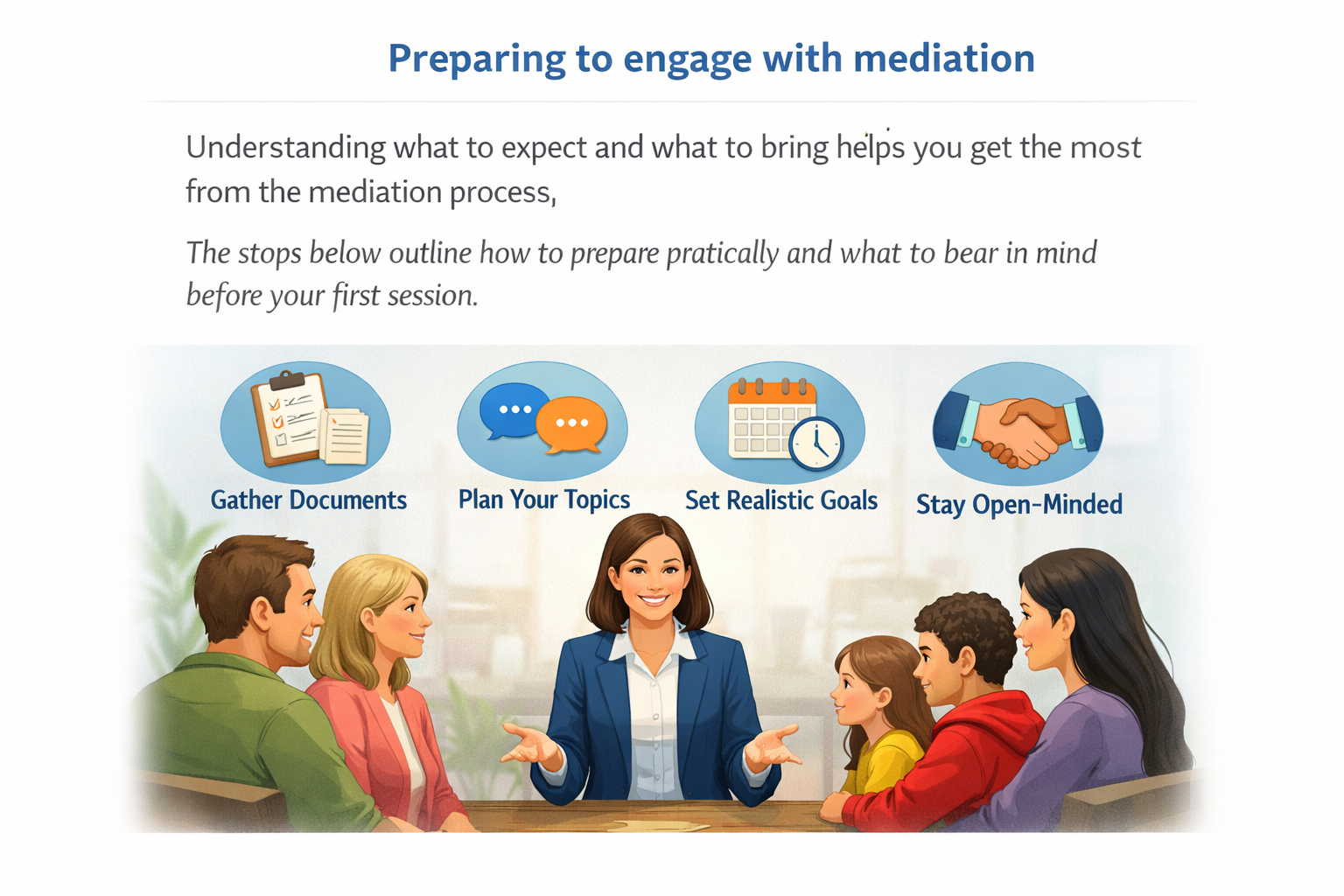
Understanding what to expect and what to bring helps you get the most from the mediation process. The steps below outline how to prepare practically and what to bear in mind before your first session.
EH Mediation is dedicated to helping families move from turmoil to clear, practical arrangements that people can live with. Our priority is creating a safe, confidential space where everyone can be heard without pressure, judgment, or surprise.
Through careful listening and structured conversations, our mediators help translate difficult emotions and competing needs into concrete, manageable decisions. Wherever children are involved, we place particular emphasis on preserving stability: predictable routines, consistent caregiving arrangements, and clear agreements that protect their normal daily rhythm.
You can expect clarity and neutrality throughout. We explain the process plainly, outline possible outcomes, and highlight practical implications so that the choices made are realistic not idealised. Agreements reached in mediation are written down clearly, with attention to timing, responsibilities, and review points.
Above all, our aim is solutions that reduce conflict, protect routines, and make everyday life easier for everyone involved carried forward with sensitivity, patience, and a focus on outcomes that truly last.